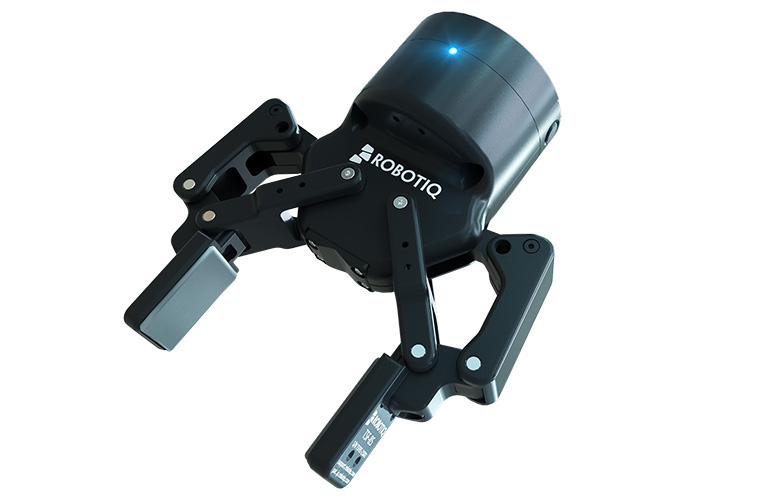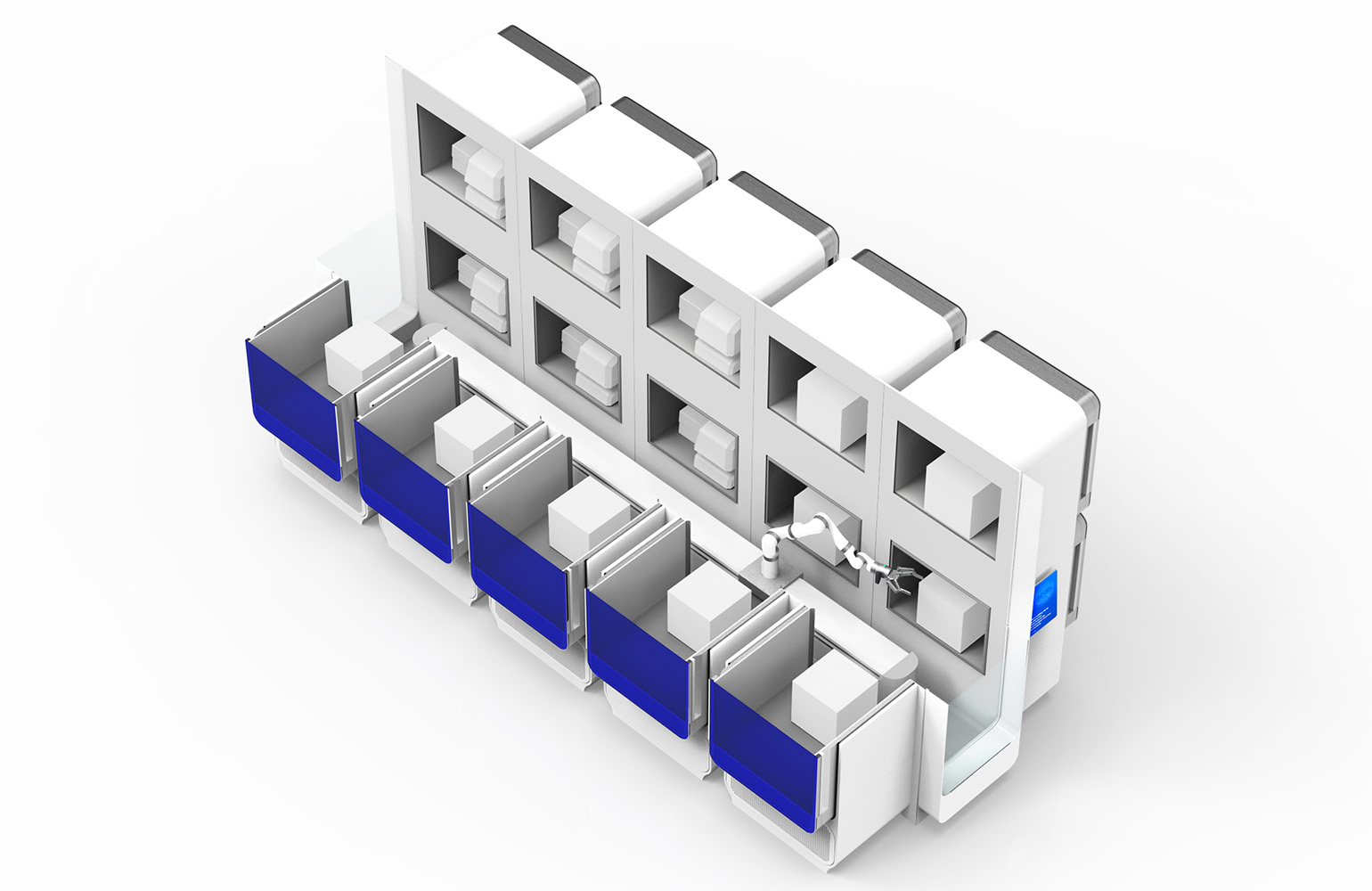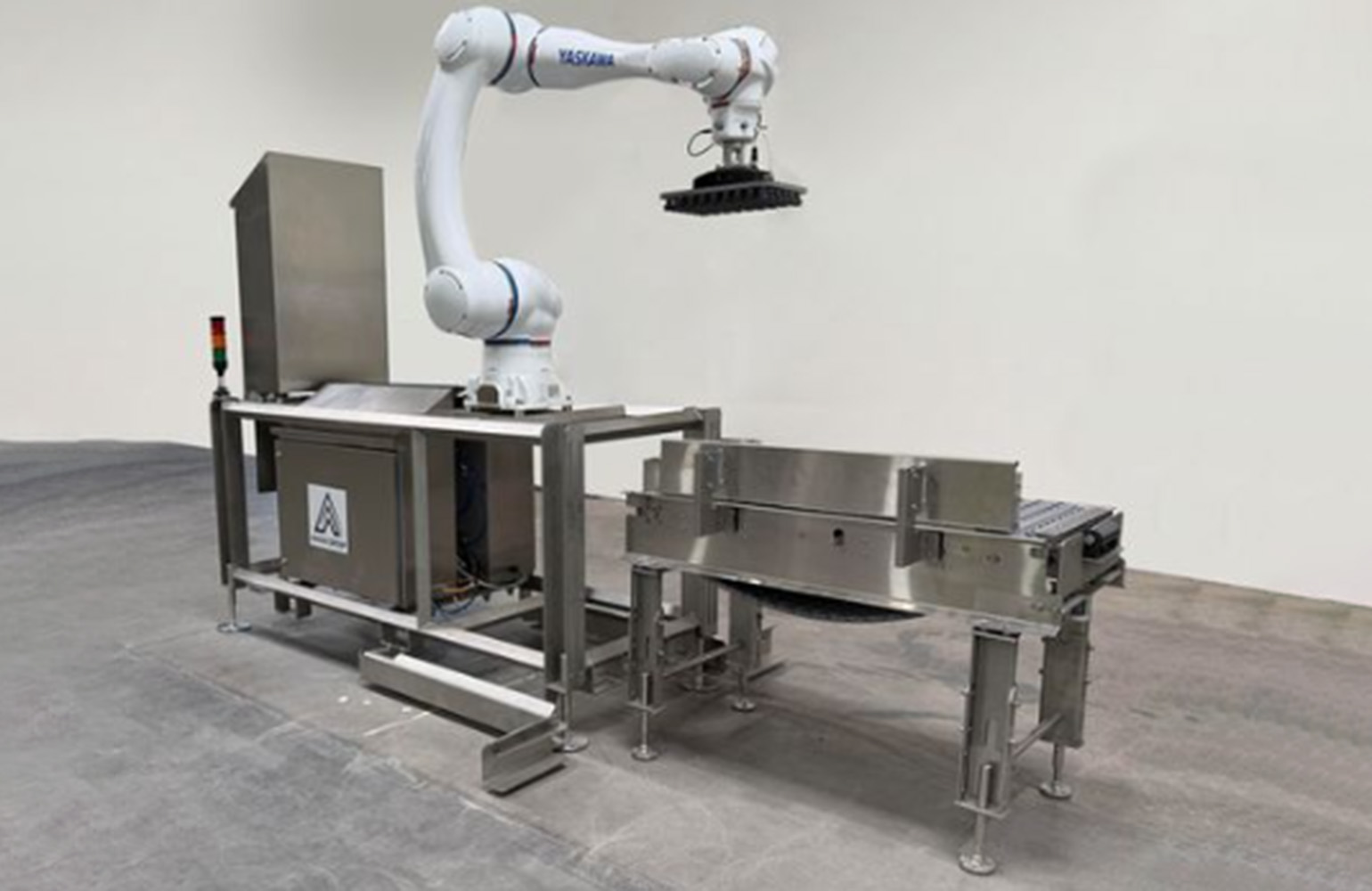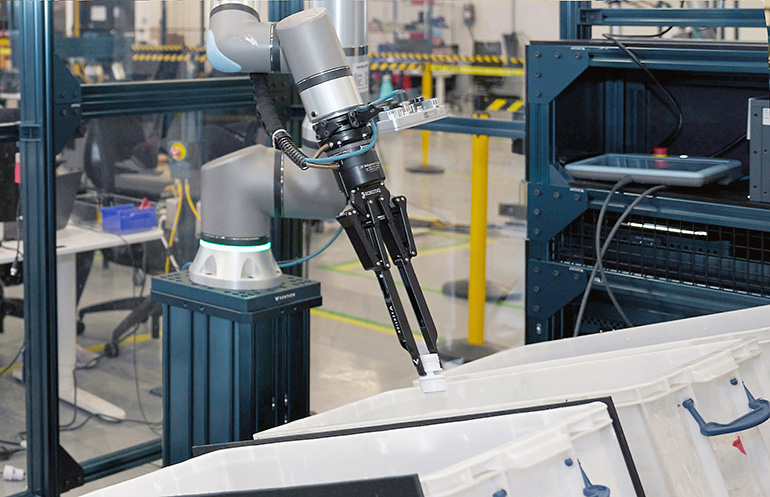
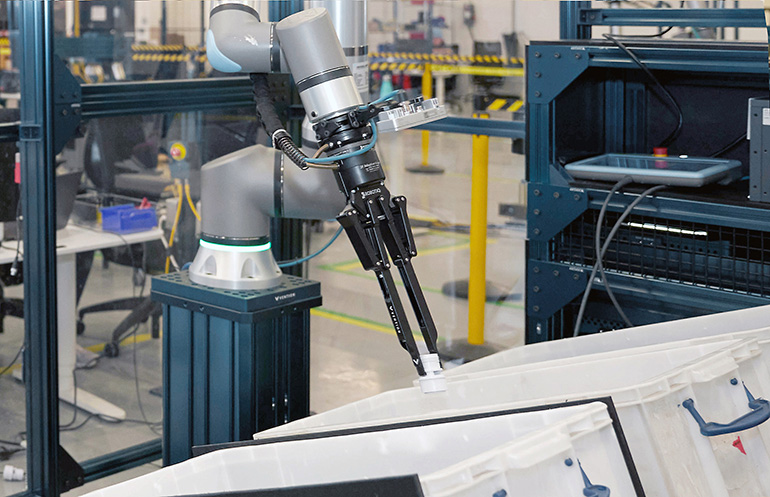
Vention is developing physical AI to unify and accelerate deployment of robotic workcells. Source: Vention
Physical AI, the union of artificial intelligence and robotics, is moving toward wider use. Vention Inc. today said it has raised $110 million ($150 million CAD) in Series D funding to advance its research, add capabilities to its software, expand its portfolio of pre-engineered applications, and grow its presence from North America to Europe.
Traditional automation is complex and requires a lot of integration work, according to the Montreal-based company. Vention said its Zero-Shot Automation platform combines hardware, software, physical AI, and cloud connectivity to enable faster and more scalable automation of production in support of reshoring.
“Manufacturers no longer want automation that requires deep expertise and long commissioning cycles,” stated Etienne Lacroix, CEO of Vention. “They want automation that works as intuitively and reliably as modern software. Physical AI is allowing us to deliver exactly that.”
Vention playbook includes four targets
“We’re making automation more accessible by moving integration activities to our online platform,” Lacroix told The Robot Report. “We’re going to use the the funds to power four playbooks. The first is serving enterprise clients.”
“Vention has become a standard within enterprises — 40% of our revenue comes from companies with $1 billion or more in revenue,” he said. “In the past, automation was decentralized, with separate integrators. Enterprises ended up with orphan machines with spaghetti code.”
Many manufacturers want turnkey offerings, in which everything on the factory floor is governed by standardized platforms while retaining access to data models, digital twins, and code, explained Lacroix.
Vention’s second playbook is to continue commercializing physical AI from its roots in research and development. “We’ve always been an innovation powerhouse — that’s why NVIDIA joined as an investor; it saw how fast we’re moving in real industrial use cases,” said Lacroix.
NVIDIA last year partnered with Vention on motion control and vision AI, and the partners plan to announce new products soon, he added. Vention has launched automated configuration tools, an AI agent for defining machine specifications, a robotic programming co-pilot, and AI-powered robotic applications. It claimed that these tools can reduce automation project timelines from months to days.
The third playbook is to build depth in Vention’s “end-to-end” offering.
“We’re the broadest industrial tech stack,” Lacroix asserted. “We do design, programming, simulation, ordering, deployments from the cloud and digital twin to the floor, plus the operating layer and teleoperation. We’re not the deepest in all those verticals, but we’re continuing to build that depth.”
The fourth playbook is Ventions expansion in Europe. The company has about 310 employees and has 30 open positions. In 2025, it added senior project managers and U.S.-based salespeople and customer success team members. Vention also invested into physical AI researchers last year.
Manufacturers demand reliability, speed
Vention serves 25 discrete manufacturing industries, said Lacroix. Promising segments this year include defense, data center and AI, and end-of-line automation.
“We have people in the U.S. certified to serve heavily regulated defense clients,” he noted. “Defense is trying to move fast in Canada and Europe, and a whole class of startups is emerging. There are already a few winners in drones and submarines.”
“We don’t manufacture hyperscalers, but it turns out that a lot of their cooling systems are now assembled in Vention-automated assembly lines,” added Lacroix. “We’re putting a lot of emphasis this year on physical AI, because we can figure out a way to take the technology in its current state and create a 99% reliable application at the speed of a human.”
“If a manufacturer is operating two shifts, it needs to figure out a way to deploy physical AI for roughly $150,000,” Lacroix said. “Physical AI applied to manufacturing can grasp and position physical objects very precisely. We have good traction in consumer packaged goods and with Fortune 500 companies. They have mostly brownfield facilities but want modular automation that can be deployed quickly.”
He said Vention’s tech stack is robot-agnostic, providing robot compatibility without the need to tweak robot drivers. The company started 10 years ago with the Robot Operating System (ROS), which was well-built but slow, recalled Lacroix.
“Every half-second counts,” he said. “We built a more efficient robot control layer to be 1:1 with robot planners. They can’t live in controllers, they have to be in the cloud. The systems on the factory floor need to run at the same speed as native planners.”

Vention stays focused on generalizing its platform
New and existing investors in Vention included Investissement Québec, Desjardins Capital, certain funds managed by Fidelity Investments Canada ULC, and NVentures (NVIDIA’s venture capital arm).
“We’re quite excited to reach this milestone and have raised $260 million in total capital,” said Lacroix.
While humanoid robots and generalized AI have garnered a lot of attention lately, Vention is staying focused on robot arms and autonomous mobile robots (AMRs). It has deployed more than 25,000 machines worldwide in over 4,000 factories.
“We have discussions all the time about humanoids specific to manufacturing,” Lacroix acknowledged. “We looked at generalized platforms for fit-for-purpose workcells and said, ‘Let’s not generalize the robot, but generalize the platform to lead fit-for-purpose robots.’”
“Vention’s AI pipeline uses robust models for real-time collision avoidance and pose estimation that we couldn’t have dreamed of just a year ago,” he said. “We’ll have a stream of announcements in the coming months, and we’ll be at GTC, Automate, and IMTS, as well as Pack Expo and Hannover Messe.”
The post Vention raises $110M to accelerate physical AI deployments in manufacturing appeared first on The Robot Report.