While some politicians celebrate eliminating foreign competition and many drone operators worry about business closure, American drone manufacturers are navigating a more nuanced reality than either narrative suggests.
I spoke with Shane Beams, CEO of Vision Aerial, and Susan Roberts, the company’s Chief Marketing Officer, about how they’re approaching the FCC ban, what American manufacturing actually looks like and why they advocated against grounding existing DJI fleets despite being something of direct competitors.
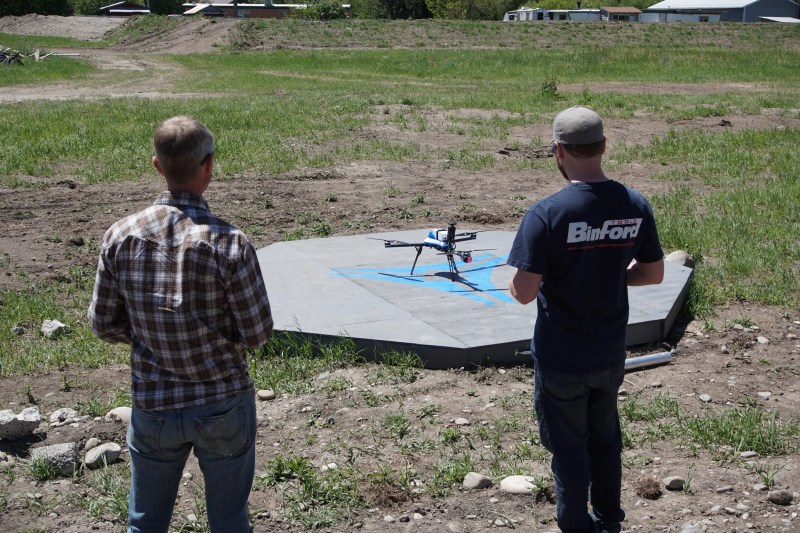
Vision Aerial is based in Bozeman and builds enterprise drones focused on commercial and public asset inspection applications. Its single largest customer is the U.S. Forest Service, which uses Vision Aerial drones for wildfire monitoring and management.
Their perspective challenges the simple story that American companies are uniformly celebrating regulatory protection.

To ban or not to ban DJI drones?
Some American drone companies certainly have advocated in favor of — or applauded — widespread bans on Chinese drones.
“We applaud the Administration’s decision to act with urgency,” said Red Cat CEO Jeff Thompson in a prepared statement issued the day after the ban was announced. “The FCC’s action sends a clear signal that the U.S. is serious about securing its airspace, backing trusted technology, and leveling the playing field for U.S. manufacturers competing with foreign-subsidized products.”
But not all American drone companies came out that strong. In fact, Vision Aerial is among the companies that actively lobbied politicians to ensure the FCC ban didn’t ground existing DJI drones.
“We did advocate with our politicians to not make the ban retroactive,” Vision Aerial CEO Shane Beams said in an interview with The Drone Girl. “We did not want the DJI fleet grounded. That would’ve been very, very bad for the industry.”
Their perspective brought in something that many have suggested the politicians behind the FCC ban failed to understand: You can’t build a healthy drone industry by destroying the existing one overnight.
“I think for the next 12 to 18 months it’s going to cause short-term pain,” Beams said. “I’m glad to see they allowed the firmware updates. That would be the first thing to brick aircraft, especially from DJI. Props and rotors and batteries are probably the next thing in queue, but generally there’s a big stockpile of those. There’s a good chance that’ll last for a couple of years for people.”
What does America’s drone manufacturing scene look like?
The definition of “made in America” varies widely, but there is some clarity of an official definition of what “American-made” means. Under the Federal Acquisition Regulation (FAR)’s Buy American Act, products must be 65% American-made (as measured by cost, not literal size of the item), to be considered American-made in government eyes. That 65% threshold is set to increase to 70% by 2029.
And in fact, an early January 2026 update to the FCC drone ban created an exemption where products that meet the 65% Buy American standard would still be eligible for FCC approval.
Vision Aerial has been systematically bringing manufacturing in-house since 2013 — long before the FCC ban made it politically fashionable.
“From day one in 2013, we’ve in-sourced parts and the manufacturing of those so that we had control over quality and more importantly than anything is lead time,” Beams said. “100% of our unique parts are made in America, and most of those even in our shop in Montana.”
For Beams, a big reason to keep manufacturing in America was never about nationalism nor regulatory compliance, but rather about business strategy.
“In a highly adaptive market where the products are changing fast, it’s an advantage to be able to adapt equally rapidly, in-sourcing our parts empowers that,” Beams said.
The ability to iterate quickly requires controlling your supply chain, not waiting for shipments from overseas manufacturers. But even with extensive domestic manufacturing, certain components remain challenging.
“There are definitely commoditized parts that are a risk for the drone manufacturing industry, as well as many other industries,” CMO Susan Roberts said.
Vision Aerial currently uses batteries from Samsung (South Korea-based), Amprius (U.S.-based), and is in talks with other American suppliers. For motors, rotors, and flight computers, Vision Aerial maintains multiple suppliers as backup.
“We have about 900 unique SKUs in the company, all of which have individualized supply chain plans,” Beams said. “We have primary, secondary, tertiary for almost all of those parts. That actually saved our bacon during COVID.”
Will American drone companies finally build something to compete with the DJI Mavic?
The history of American consumer drone companies is littered with expensive failures. 3D Robotics burned through nearly $100 million before abandoning hardware. GoPro recalled its entire Karma drone line after disastrous reviews. Lily Robotics raised $34 million and never shipped a product. Skydio gave up on consumer drones entirely to focus on enterprise and government contracts.
Beams’ answer for why this keeps happening is blunt: “DJI has received many million dollar checks from the Chinese government.”
Beams suggested that the U.S. government should be investing in American drone companies in a similar manner.
“It’s exactly like the space race. If you look, Russia said, ‘Hey, we want to get to the moon.’ America said, ‘Hey, we want to get to the moon,’ and they didn’t shut down the components. They invested in their own.”
Beams’ preferred solution was matching China’s investment strategy, not banning the competition: “If our federal government stepped in and said, ‘Hey, we’re going to win the drone race against China,’ that would have been fun and awesome, and humans would have benefited.”
Instead, America chose regulatory protection over direct competition.
There have been some attempts at better investing in American drone companies, such as the $50 billion CHIPS and Science Act, which President Joe Biden signed into law in 2022. That Act allocated $1 billion for small manufacturing investment through “tech hubs.” In short, it meant to subsidize the semiconductor industry by using taxpayer money to build up domestic production capacity (thus removing reliance on Chinese-made computer-chips).
Vision Aerial’s Beams said he was ultimately disappointed with how the program evolved. Rather than investing directly in American manufacturers, it has morphed into more of a training program.
“Unfortunately that mechanism has turned into more jobs programs and training programs,” Beams said. “That’s only really valuable if there are jobs for those machinists to then go and operate mills on. Without those superior products and services, it’s pretty hard to have the jobs behind them.”
The price equation
One reason why DJI has dominated as the drone of choice for small businesses and even taxpayer-funded agencies is their low costs. Will American manufacturers build affordable consumer drones now that DJI is restricted?
Beams is cautiously optimistic, but realistic: “It’d probably be more like we can build an $8,000 drone that’s even more feature-rich than a Mavic. It might not be $2,000, but it might be cheaper than where American drones are today. Maybe half or a third. Maybe not 10% or 20%. But I think it’ll move in that direction.”
Vision Aerial operates in the industrial/enterprise space, not consumer drones. Their products are designed for professional use cases — Forest Service wildfire monitoring, infrastructure inspection, industrial gas detection — where a $20,000-$100,000 drone makes more economic sense than what a real estate photographer looking for simple aerial shots would be able to afford.
This focus on high-value applications is common among surviving American drone companies. Red Cat’s Black Widow is designed for military tactical operations, not real estate photography. Skydio’s X10 targets enterprise and government customers at price points around $10,000-$15,000. These companies compete on capability and mission-specific features, not consumer affordability.

What sorts of growth you should expect from American drone companies in light of the ban
With the FCC drone ban, many investors have wondered if now is a good time to invest in American drone companies, or whether companies will see explosive growth in general.
Roberts said to realistically expect a more gradual timeline.
“In these industrial spaces, people have different planning cycles,” she said. “Someone who was buying was already buying. Someone who is expanding their program is already expanding their program. It’s a matter of being in their planning cycles for things coming at the end of this quarter, the beginning of next quarter.”
Plus, given that the ban restricts future foreign-made drones rather than grounding current drones (as a once-proposed ban from the Commerce Department would have done), don’t expect companies to rush to replace functioning equipment.
“If they have a fleet of two, they’re not going to suddenly replace them,” she said. “If they have a fleet of 200, they’re not going to suddenly replace them. They’re going to try to keep them and get their investment over time.”
The FCC drone ban will likely evolve
And then there’s the fact that the drone ban announced in late 2025 might not remain in its current form in a year or two. We’ve already seen exemptions roll out, and more legal challenges are expected.
Vision Aerial’s leaders say the company strategy doesn’t depend on the ban remaining.
“The impact to Vision Aerial is that it won’t materially change the path we’ve been on of pulling components domestically for manufacturing and sourcing,” Roberts said. “We have a steady pipeline now that’s built on the back of our longevity in the market and our reputation.”
This is the fundamental difference between companies that were actually building competitive products versus those that needed regulatory protection to survive.
The post What do American drone companies think about the FCC ban? (It’s more complicated than you’d think) appeared first on The Drone Girl.