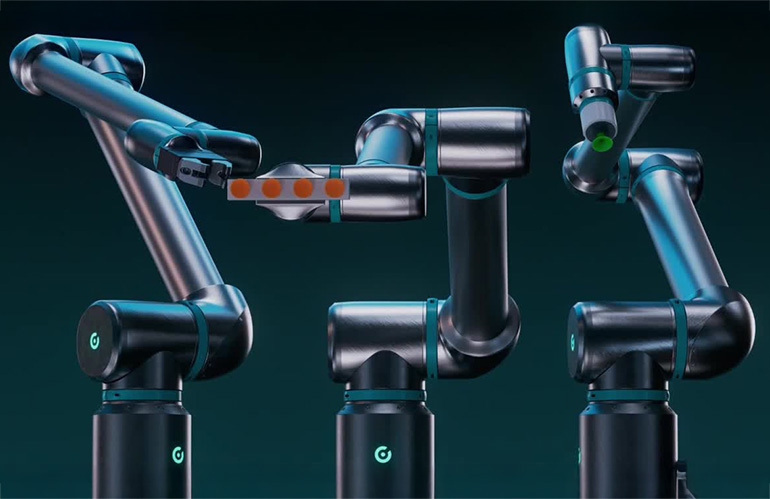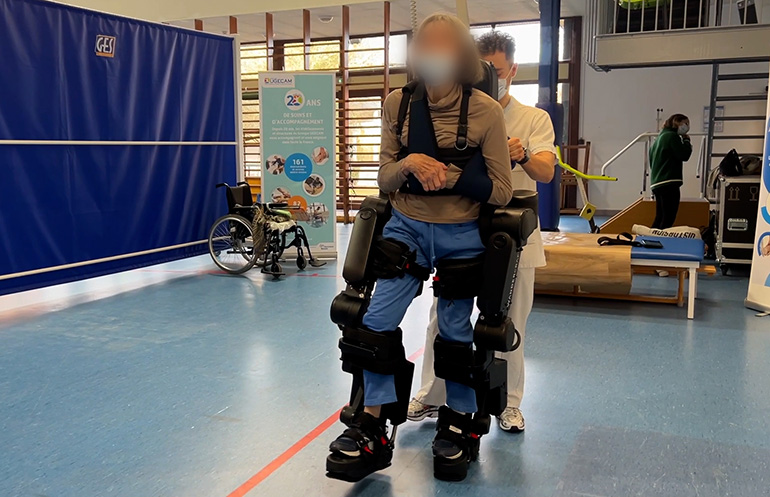
The Atalante X self-supporting exoskeleton is being tested for clinical use. Source: Wandercraft
Robotics and wearable technologies show promise in helping patients in rehabilitation. The first patient has enrolled in a new clinical trial at Brigham and Women’s Hospital for Atalante X, a robotic exoskeleton from Wandercraft.
“This pilot study is designed to answer an important, practical question: Can Atalante X, a self-balancing exoskeleton, be used safely and effectively in a thoracic surgical ICU [intensive care unit]?” said Matthieu Masselin, co-founder and CEO of Wandercraft.
Thoracic surgery patients are often unable to stand for even a minute without the assistance of two or more healthcare providers, according to ICU clinicians. The first days after surgery are often a difficult period for mobilizing a patient, but even a few minutes of upright posture can benefit cardiorespiratory function, vital sign stability, muscle preservation, and psychological well-being, Wandercraft noted.
“Early mobilization is one of the most effective and underused tools we have to improve outcomes after thoracic surgery,” said Raphael Bueno, M.D., chief of the Division of Thoracic Surgery at Brigham and Women’s Hospital, a founding member of the Mass General Brigham healthcare system and a teaching hospital of Harvard Medical School.
“This trial allows us to explore whether an exoskeleton can help us mobilize patients earlier, safer, and more consistently than is possible today,” added Bueno, who is also the Lawrence Harvey Cohn Professor of Surgery in the field of cardiothoracic surgery at Harvard Medical School. “Enrolling the first patient marks an exciting step forward for this study.”

Atalante X supports people with complex conditions
Wandercraft claimed that the interventional pilot trial is the first of its kind and is designed to assess the clinical utility of Atalante X. The hands-free exoskeleton has been cleared by U.S. Food and Drug Administration and obtained a CE mark in Europe.
Unlike other robotic rehabilitation devices, also known as overground gait exoskeletons, Atalante X does not depend on patients using assistive devices such as walkers or crutches, said Wandercraft. The device is currently approved for use by people with spinal cord injury at levels C4 to L5 (SCI), hemiplegia due to cerebrovascular accident (CVA), or multiple sclerosis (MS).
The exoskeleton has 12 powered joints at the hips, knees, and ankles, allowing clinicians to deliver intensive and personalized gait therapy for a broad range of neurological and musculoskeletal conditions.
Wandercraft asserted that Atalante X helps patients walk, stand, and retrain natural movement patterns from their very first session. The company said this makes the wearable device especially useful for individuals with complex conditions or limited upper-body strength.
“Since commercializing Atalante X, we are now in over 100 research and rehabilitation facilities worldwide, with significant growth across the U.S., including notable institutions as Good Shepherd Rehabilitation, Moody Neurorehabilitation Institute, and Georgia Tech, and dozens of new deployments worldwide,” Masselin said. “We’re seeing patients taking 1 million steps per month worldwide and customer use with a broad range of patient populations.”
Clinical pilot to evaluate exoskeleton in multiple ways
In an interventional pilot, patients are receiving treatment and are not just being observed, explained Masselin. Eligible ICU patients will participate in structured training sessions using Atalante X, and the exoskeleton will be integrated into their care so that it can be evaluated in real-world practice.
Masselin told The Robot Report that the study, which will be open for about six months, includes four distinct evaluation domains:
- Safety, based on the number and severity of adverse events, as well as whether these events are related to the study procedures or the exoskeleton
- Feasibility, evaluated by the ability to complete two sessions per week over a two-week period, along with session duration, number of steps taken, and the level of exoskeleton assistance needed
- Usability, including the time required for donning and doffing the exoskeleton, the personnel needed per session, and patient and operator satisfaction
- Effectiveness, assessed by the Johns Hopkins Hospital Mobility Scale (JH-HLM), which measures the patient’s functional mobility
The protocol will involve at at least five adult patients in the Thoracic Surgical Intensive Care Unit at Brigham and Women’s Hospital, noted Masselin. They will participate in two exoskeleton sessions per week until they are discharged from the ICU.
“The overall study design aims to understand how the technology performs in practice and what it takes to deploy it safely and effectively in an ICU,” he said. “This kind of feedback is exactly what guides future improvements in patient care and clinical integration, including reducing the staffing burden needed to mobilize critically ill patients. These insights could also be valuable to our current Atalante X users and their care teams.”
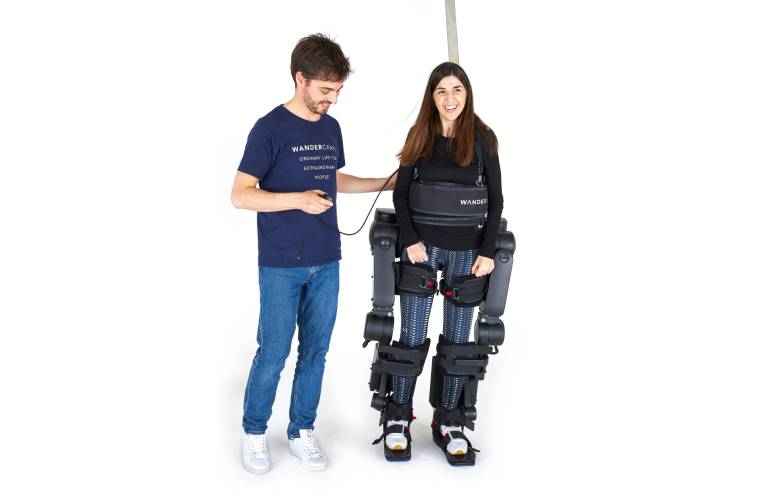
Atalante X will be part of ICU treatment in the trial. Source: Wandercraft
Wandercraft works to bring Eve into the home
Founded in 2012, Wandercraft is developing self-balancing, AI-enabled mobility systems to restore walking ability both at home and in rehabilitation. The Paris-based company has more than 30 patents, and its products include the Eve personal exoskeleton.
“We’re really excited to bring our technology into the home,” said Masselin. “Eve is designed to support individuals living with mobility impairments in their everyday lives. Clinical trials started in 2025, with commercial availability anticipated later this year.”
“For many users, walking without crutches or walkers – or at all – was once unimaginable,” he said. “As the world’s first self-balancing exoskeleton for personal use, Eve is designed to transform mobility by enabling users to walk hands-free both at home and outdoors.”
In 2025, Wandercraft expanded into industrial robotics with the launch of Calvin-40, a humanoid robot announced in with its strategic partnership with Renault Group. The company built Calvin-40 on the same robotics platform as its medical exoskeletons. The robot is engineered to perform physically demanding or hazardous tasks in real-world environments, starting with manufacturing.
The post First patient enrolls in clinical trial for Wandercraft Atalante X exoskeleton appeared first on The Robot Report.