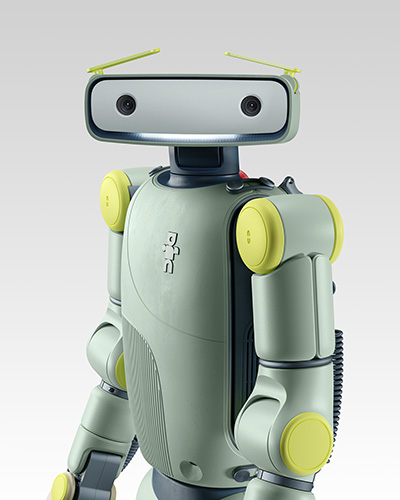
In the high-stakes artificial intelligence race, New York-based Fauna Robotics is betting that the path to general intelligence runs through the physical world.
Led by founders Rob Cochran and Josh Merel, the startup is developing a specialized hardware and AI platform to move robots out of factories and into the unstructured environments of everyday life.
By engineering safe, lightweight, and inexpensive machines, Fauna said it aims to create a data-driven “flywheel” for embodied AI. The company said it is pursuing a vision where general-purpose robots don’t just perform tasks, but also live, work, and play alongside their human counterparts.
Startup focuses on building applications over teaching fundamentals
Cochran described the concept for Sprout to The Robot Report: “It gives people the tools to start building interesting applications, rather than focusing on the kind of fundamentals that make it quite a small community of roboticists that are able to actually engage with robotics today, and so that feels like a really great opportunity.”
He added that Fauna was founded on the idea of solving problems immediately. “One of the things we identified when we started this company is … now is the time when we can maybe start to solve some general-purpose robotics problems and in a general-purpose form factor, like a humanoid,” Cochran said.
Sprout is engineered for expressive engagement within human-centric environments. These interactions are enhanced by an articulated neck that provides a controllable gaze, allowing Sprout to “look” at people and objects.
Fluid movements of the arms and torso further humanize the robot, enabling it to perform social gestures like high-fives, handshakes, and playful poses that bridge the gap between machine and companion, according to Fauna Robotics.
Sprout designed for positive interactions with people
Fauna Robotics said it balanced a friendly aesthetic with rigorous safety features in Sprout. The robot’s compact, lightweight frame has soft exterior panels and back-drivable motors to minimize impact forces and ensure safe interactions.
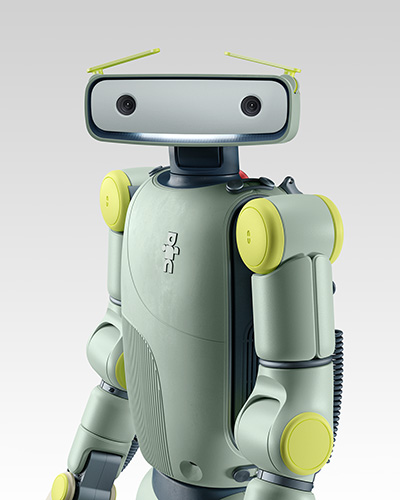
Standing at 107 cm and weighing just 22.7 kg, Sprout is designed to be inherently safe. | Credit: Fauna Robotics
The company said it engineered Sprout’s physical form factor for approachability. With a maximum size of 107 cm (42 in.) and weighing 22.7 kg (50 lb.), the robot is intended to be unintimidating, particularly for children.
In addition to its small size, Sprout works with a dedicated safety subsystem that monitors real-time conditions to enforce constraints across all mechanical and software levels, explained Fauna.
Beyond its protective design, Sprout emphasizes emotional connection through a character-like appearance, which includes an articulated neck, actuated eyebrows, and an LED array that facilitates natural, non-verbal communication and social trust.
The robot’s modular architecture has 29 degrees of freedom and is designed for both durability and ease of use. It has a 3.5-hour swappable battery and a resilient build capable of recovering from falls.
Fauna asserted that this blend of approachable materials and personalized aesthetics supports its mission to build a versatile platform for education, therapy, and interactive research.
Fauna Robotics builds a platform for AI development
Sprout also serves as a high-performance, scalable platform powered by the NVIDIA Jetson AGX Orin for advanced perception and decision-making.
For developers, the platform offers a streamlined experience through stable APIs and containerized services that support everything from low-level motor control to high-level autonomy. By using consumer electronics manufacturing processes and a low part count, Fauna said its design ensures that Sprout can scale efficiently from research labs to mass-market production.
Cochran compared Sprout to the early development of PCs.
“The analogy I like to draw is to the early days of personal computing, [where] it wasn’t really until you had certain things like the Apple II and the invention of BASIC, the programming language, that you had this abstraction that allowed for the concept of an application developer,” he said. “And then you started to get interesting applications, and then the market got bigger. I think that same trajectory could make a lot of sense in the context of [physical AI-based] robotics as well.”

Sprout is more a character rather than a machine
Core to Sprout’s design is a character-like presence over utilitarian machinery, drawing on popular culture to foster immediate emotional connections, said Fauna Robotics. Sprout appears more like an animated character come to life than an industrial machine.
Central to this design approach is a “non-screen-based” facial design that emphasizes physical embodiment rather than digital displays. With its motorized eyebrows and LED array, the robot can convey a wide range of emotions and intentions, such as “thinking” animations or safety warnings, making it more relatable and engaging for human interaction, Fauna said.
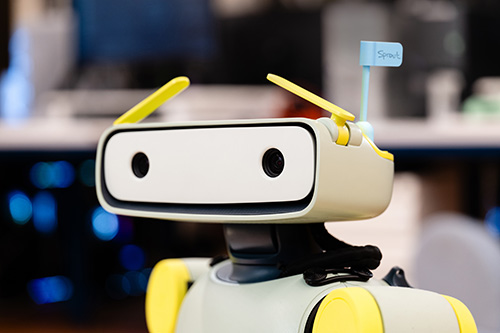
Sprout features a “non-screen-based” facial design that emphasizes physical embodiment rather than digital displays. | Credit: Fauna Robotics
These physical cues are governed by a slot-based behavior hierarchy, ensuring that visual and mechanical elements work in harmony to produce coherent, lifelike behaviors.
“We’ve provided a software and developer experience packaged around this idea that you can do very low-level programming on this,” Cochran noted. “But you also get mapping and navigation and voice interaction, and HRI features right out of the box.”
To facilitate natural social engagement, Sprout incorporates a sophisticated audio-visual and movement suite. A four-microphone array enables speech recognition and sound-source localization, while integrated speakers allow the robot to respond with speech, sound effects, and tones that complement its physical gestures.
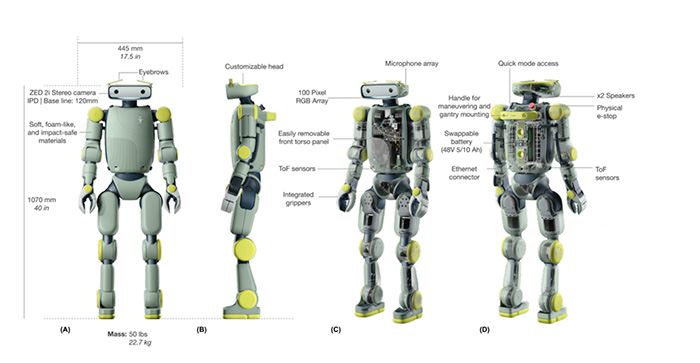
Hardware overview. Key features of the Sprout robot platform from different perspectives: (A) and (B) are true-color renders (C) and (D) are semi-transparent renders. | Credit: Fauna Robotics
Full specifications for Sprout are available on the Fauna Robotics product page.
The robot’s soft, deformable exterior panels encourage physical contact, while the inclusion of standardized interlocking toy brick components allows for cosmetic customization (see image below).
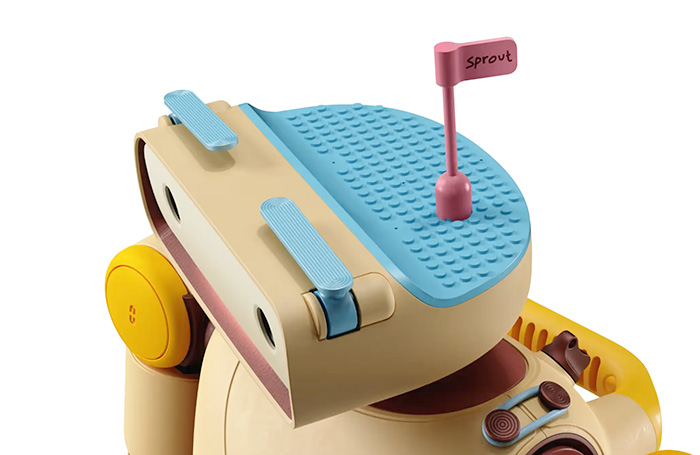
Sprout includes a plastic grid structure on its head, suitable for attaching LEGO bricks, to personalize the robot. | Credit: Fauna Robotics.
The post Introducing Sprout, a new humanoid development platform appeared first on The Robot Report.