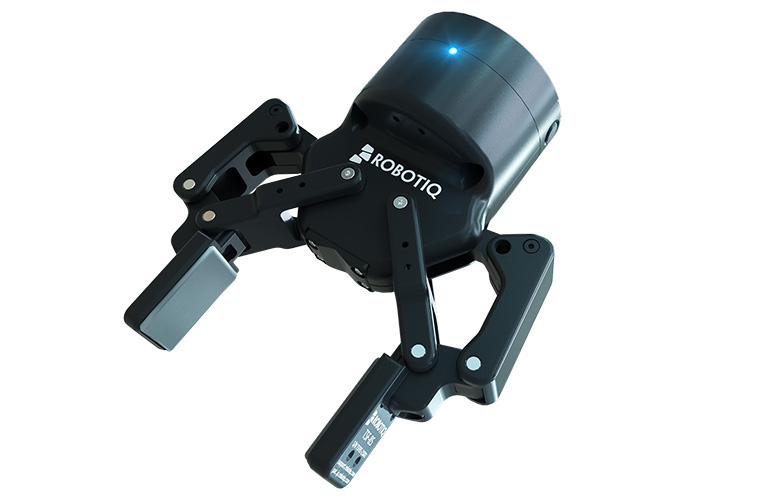
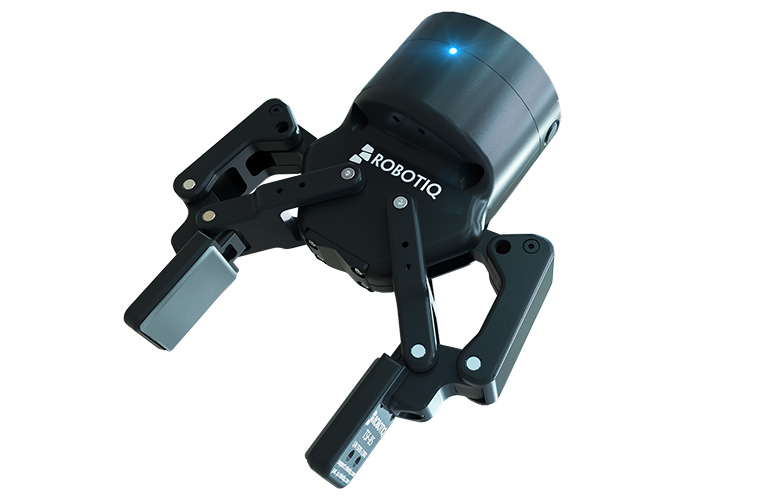
Rending of the TSF-85 tactile sensor fingertips on the 24-85 Adaptive Gripper. Source: Robotiq
Robotic end effectors do not need to be humanoid to be more sensitive and effective, according to Robotiq Inc. The company today launched the TSF-85 tactile sensor fingertips for its 2F-85 Adaptive Gripper. It said that its integrated sensing enables robots to reliably feel, understand, and interact with the world at scale.
“Physical AI demands more than clever algorithms—it demands reliable interaction with the real world,” stated Vincent Duchaine, chief technology officer for artificial intelligence at Robotiq. “By combining adaptive gripping with high-frequency tactile sensing, we’re giving robots the sense of touch and control they need to generalize across objects, tasks, and environments without the cost and complexity of anthropomorphic hands.”
Founded in 2008, Robotiq said it built the TSF-85 on years of research and field experience, with more than 23,000 grippers deployed worldwide. The Lévis, Quebec-based company said leading AI labs and manufacturers use its products to “bridge the gap between digital intelligence and physical reality.”
Robotiq commercializes university R&D
“Tactile sensing has been in academia for a long time,” noted Jennifer Kwiatkowski, an AI specialist at Robotiq. “Robotics companies are realizing the limits of what vision can do for planning, navigation, and manipulation in terms of their robot perception stacks.”
Robotiq’s tactile sensor came out of research that Kwiatkowski worked on at the École de technologie supérieure (ETS) in Montreal, she told The Robot Report.
“My research was on grasp stability prediction using these sensors and AI,” Kwiatkowski said. “There have been other experiments around object and texture recognition, as well as detecting if there’s a crack in a piece. If you’re squeezing different objects, can you recognize them?”
“Robotiq recognized that we had something, having been involved with end-of-arm tooling [EOAT] for 17 years,” she added. “The gripper is the way that the robot interacts with the world, so all of your perception at the end of the arm is what makes your robot useful.”

2F-85 gripper designed for sensitivity, simplicity
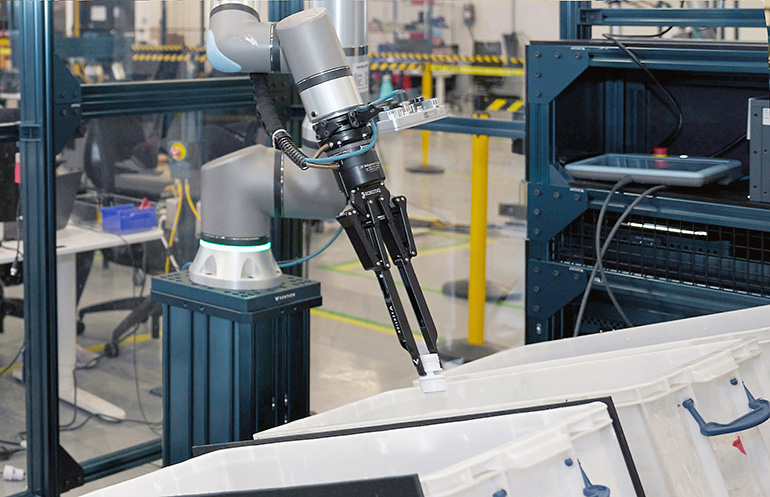
While parallel grippers rely on precise positioning and rigid alignment, Robotiq said its 2F-85 EOAT offers both pinch and encompassing grips, with stroke lengths of 85 and 140 mm (3.3 and 5.5 in.). It said this allows the gripper to conform to an object’s shape, reduces grasp planning complexity, and minimizes reliance on unobstructed vision, making it suitable for handling a wide range of objects.
Robotiq listed the following capabilities:
- A 4×7 static taxel grid to monitor force distribution
- Micro-slip detection at 1000 Hz for stable, precise manipulation
- An integrated IMU (inertial measurement unit) for proprioceptive sensing and contact awareness
“Unlike other sensing mechanisms — optical or magnetic — we’re capacitor-based, like a smartphone touchscreen, which is well-established,” explained Kwiatkowski. “We focus on having good integration of the sensor into the robotic hand, which has to be reliable in the warehouse.”
The tactile-enabled 2F grippers integrate into existing robots using native RS-485 communication and a USB conversion board, said Robotiq. The tactile fingertips are designed to preserve grip mechanics with minimal impact on stroke and reach, and they feature robust cabling.
Robotiq touts durability, scalability of EOAT
Robotiq said that thousands of its grippers are already operating in demanding research and industrial environments worldwide. It claimed that its grippers have a lower bill of materials (BOM) and replacement cost than anthropomorphic or DIY hands, reducing cost and providing “a practical path from lab prototype to large-scale robot fleets.”
“We’re in the process of doing tests, but the threshold we’re looking to match is our grippers’ lifecycles, which is on the order of millions of cycles,” Kwiatkowski said. “Another interesting element of our design is scalability. These sensors are not too complex to manufacture, which is important to us if we’re getting orders for hundreds of thousands of grippers.”
“Articulated hands are harder to control and have more failure modes,” she said. “Humanoid hands are very cool, but they’re more of a 10-year play, while we’ll be ready to ship units in the coming months and iterate toward the best sensor that fits the most use cases.”
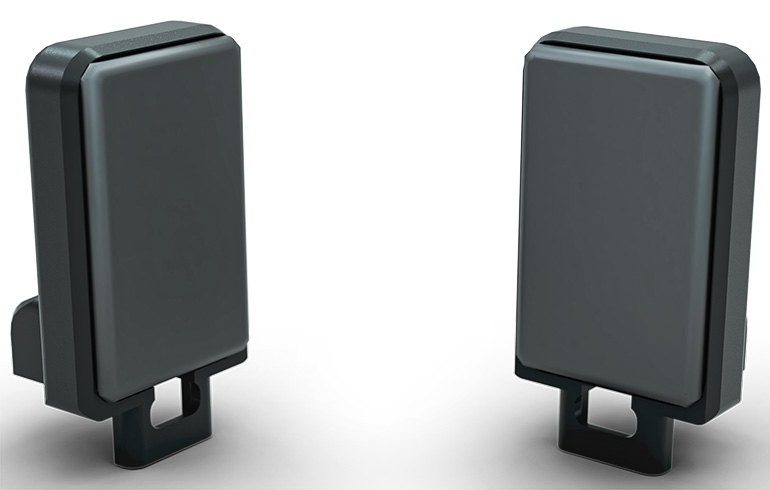
The new tactile sensor fingertips are designed to be manufactured at scale. Source: Robotiq
TSF-85 sensors to provide data for physical AI
Robotiq said it shares best practices for tactile data handling, including guidance on bias management, normalization, and outlier detection, to help teams generate consistent, high-quality data for model training. It asserted that its sensors enable robots to understand contact geometry, detect incipient slip, and improve generalization across diverse objects, all of which are necessary for physical AI datasets.
“It’s important to make sure that you’re aligning your data collection to the appropriate tasks so that you’re not wasting time,” said Kwiatkowski. She cited three mechanisms of the human sense of touch — sustained or fast changes in pressure, vibration, and configuration of the hands. These shape perception of an object’s shape as well as grasping and manipulation capabilities.
The lack of reliable data across sensor modalities has hindered the development and production of physical AI, according to Robotiq. The company said that its standardized hardware and tactile data provide a base for reinforcement learning, vision-language-action (VLA) models, and imitation learning.
No matter how good simulations may be, developers still need real-world data as they build toward generalized systems, Kwiatkowski said. “At the Humanoids Summit, I heard how physical AI is growing into operational AI, but it needs 99.9% reliability,” she recalled.
“To build physical AI that truly works, you need hardware that can sense, respond, and learn from every interaction,” said Aleksei Filippov, head of business development at Yango Tech Robotics. “That’s why we chose Robotiq. With Robotiq precision force control and reliable feedback, we capture rich sensory data from every grasp.”
“By giving robots a reliable sense of touch that combines with adaptive gripping and industrial-grade reliability, Robotiq enables the next generation of physical AI systems to learn faster, operate more robustly, and scale beyond the lab,” said the company, which is looking to collaborate with developers.
The post Robotiq brings sense of touch to physical AI with fingertips for 2F grippers appeared first on The Robot Report.